
'While the President has been critical of India, he has gone out of his way to compliment PM Modi. They have an incredible relationship.'
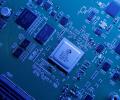
The Indian government is keen to woo major semiconductor players, but a global race to attract them to countries where there is already an ecosystem is making it difficult for India to attract the biggies in the business. On Wednesday the government decided to throw open the doors to more players to participate in its semiconductor scheme. It is now looking at not only 28 nanometre (nm) chips and below, but higher nodes like 40 nm.

Commerce and Industry Minister Piyush Goyal on Thursday asked the Indian startup community to shift their focus from grocery delivery and ice cream making to to high tech sector like semiconductor, machine learning, robotics, and artificial intelligence. He also said there is a need for more Indian investors into the startup ecosystem.

'Maharashtra, Telangana and Karnataka were competing for the Foxconn-Vedanta semiconductor manufacturing plant'
The global semiconductor shortage is turning into a headache for automotive (auto) and appliance manufacturers. But it is proving to be a boon for equity investors. Semiconductor stocks are among the best performers this year. The PHLX Semiconductor Index has gained more than 35 per cent year-to-date.
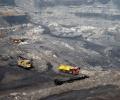
The 17 rare earth elements that are at the centre of the current crisis are critical components of everyday products -- from cars to jet engines to electronics like smartphones and flat-screen TVs.

Inventories of rare earth magnets used in critical automotive components - particularly electric vehicle (EV) traction motors and power steering systems - could run dry by mid-July this year, according to rating agency Icra.

'Whoever owns the best chip industry will be the Saudi Arabia of the era of data,' predicts Rajeev Srinivasan.

In a double-dose bid to boost growth and employment prospects, the Union Cabinet on Tuesday approved a Rs 2.07 trillion outlay for a research development and innovation (RDI) Scheme to fund private sector innovations, and an employment-linked incentive (ELI) to create over 35 million new jobs over the next two years.

Here are list of some of the big ticket announcements.

In trade negotiations, as in chess, sometimes you need to accept a temporary disadvantage to secure a better long-term position, points out Sonal Varma, chief economist (India and Asia ex-Japan) at Nomura.

Artificial Intelligence, innovation and next-generation technologies figured prominently during the high-stakes discussion between Prime Minister Narendra Modi and US President Donald Trump at the White House, as the two sides announced transformative measures, including the US-India TRUST initiative, roadmap on accelerating AI infrastructure and INDUS Innovation, to boost tech ties.

India's Foreign Secretary Vikram Misri has underscored the importance of not equating the victims and perpetrators of terror attacks, highlighting the need for global unity in combating terrorism. Speaking at Raisina Tokyo 2025, Misri expressed appreciation for Japan's support following the recent terror attack in Pahalgam, India. He also cautioned against the trend of some Western countries hyphenating India and Pakistan in the context of their recent military confrontation. Misri further outlined India's economic aspirations and its commitment to becoming a factor of stability in a turbulent world.

World's largest chip maker Intel Corporation said on Wednesday that because of India's delay in announcing a semiconductor policy, the country had lost to other Asian countries for Intel's plan to set up its manufacturing plant.

Tata Electronics on Saturday began the construction of its Rs 27,000-crore chip assembly plant in Assam, which is expected to become operational next year and create 27,000 jobs initially. The plant will produce 4.83 crore chips per day using indigenously-developed technologies. The plant's Bhumi Pujan (foundation stone laying) ceremony was held at the project site at Jagiroad in Morigaon district in the presence of Assam Chief Minister Himanta Biswa Sarma and Tata Sons Chairman N Chandrasekaran.

Finance Minister Nirmala Sitharaman on Monday held a meeting with representatives of the semiconductor industry of the US and invited them to make further investments in India. The finance minister spoke about opportunities for companies situated in Silicon Valley and about the government of India's commitment to be a reliable player in the entire semiconductor value chain with dedicated incentive for the sector in mission mode through the Indian Semiconductor Mission. Last year, the government approved a Rs 76,000-crore scheme to boost semiconductor and display manufacturing in the country in a bid to position India as a global hub for hi-tech production, and attract large chip makers.

Prime Minister Narendra Modi, speaking at the India Mobile Congress in New Delhi on Friday reeled out statistics to show how India has turned into an exporter of mobile phones from being an importer and how big tech companies -- from Apple to Google -- are lining up to become manufacturers in the country. He said after the fastest rollout of 5G mobile telephony services, India will lead the world on 6G. Recalling the launch of 5G technology in the country on October 1, 2022, he remarked that within a year there are about 5 lakh 5G base stations across the country.
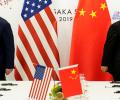
The call lasted approximately one and a half hours, and resulted in a very positive conclusion for both countries.

New investment projects announced in the manufacturing sector declined in the three months ended June 2023. The value of new projects was lower than in the March quarter, as well as the year-ago period, shows data from project tracker the Centre for Monitoring Indian Economy (CMIE). The new project announcements worth around Rs 85,000 crore in the manufacturing segment in June were a 48 per cent decline from the Rs 1.6 trillion in March and a 66 per cent decline from the Rs 2.5 trillion seen in June 2022.

iPhone maker Apple has met its replenishment target for freshwater withdrawals for corporate operations in India in 2023, the company said in its environmental progress report released on Wednesday. Globally, Apple has set a goal to replenish 100 per cent of corporate freshwater withdrawals in high-stress locations by 2030.

'Despite being a software powerhouse, we're not producing proportionate original IP, frameworks, or global tech products originating in India.'

Billionaire Mukesh Ambani's Reliance Industries and Tata Group have made it to the prestigious TIME's list of 100 World's Most Influential Companies of 2024. TIME called Reliance 'India's Juggernaut'. This is the second time that Reliance has found its way into the TIME list. Jio Platforms, the firm that holds digital properties of the conglomerate, was included in the inaugural TIME 100 Most Influential Companies List of 2021. Serum Institute is the other Indian company on the list.

India may not have got the timing right about nurturing two or three semiconductor plants even as the government finally has a policy that it hopes could put the country on the world map of semiconductor (wafer fab) manufacturing.

"On space, we will be able to announce that India is signing the Artemis Accords, which advance a common vision for space exploration for the benefit of all humankind," a senior administration official said hours before the meeting between Prime Minister Narendra Modi and President Joe Biden in the Oval Office.

'If you align your ambition with India's rise, the peak of your careers will unfold alongside the peak of India's power.'

'The size of the investments is important, but equally crucial is the number of jobs that these proposals create.'

Trump may temper his approach from time to time, but to think that he will change his basic philosophy is delusional, asserts T T Ram Mohan.

Union Minister of Heavy Industries and Public Enterprises, H D Kumaraswamy on Saturday clarified that he was misquoted on his purported remarks regarding the United States semiconductor firm Micron.
For semiconductor manufacturing (wafer fabs) plants, the threshold Net Present Value of investments would be Rs 2,500 crore and the NPV of investments for manufacturing other products would be Rs 1,000 crore.

Both new and completed project values as of December 2024 remain below pre-pandemic levels seen in 2019.

India's economic growth forecast for 2025 has been revised downward to 6.3 per cent, and despite a projected moderation, the country remains one of the fastest-growing large economies, supported by resilient consumption and government spending, the United Nations has said.

Tata Consultancy Services (TCS), the country's largest player in information-technology (IT) export, has seen a sharp decline in its contribution to the Tata group's market capitalisation in recent years though it remains the most valuable company in the conglomerate. Its 44.8 per cent share in the combined market capitalisation of the listed Tata group companies is the lowest since March 2009 and is down sharply from the all-time high contribution of 74.4 per cent at the end of March 2020.

'If the almost literally heart-stopping Suez block has any positive outcome, it is to be hoped that it will accelerate the setting up of a fab (perhaps Taiwanese) in India,' asserts Rajeev Srinivasan.

Commerce Minister Piyush Goyal's scathing remarks on Indian startup ecosystem and its innovation priorities have drawn sharp reaction from the industry, with Zepto CEO Aadit Palicha putting up a strong defence citing the company's contribution to jobs, FDI and terming it a "miracle in Indian innovation".

Whether it's Carrefour, Ford, or other foreign majors, they are ready to adjust their strategies and design their plans in a way that would address the Indian consumption story.

Industry insiders in India warn that any such move in the pharmaceutical sector could be counterproductive for the US as it may face increased drug shortages if tariffs are imposed on such imports.
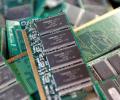
Even as India's passenger-vehicle sales touched a record high of 3.9 million units in 2022-23, growing 27 per cent over the previous financial year, the country's largest carmaker, Maruti Suzuki India (MSIL), said on Monday uncertainties in the electronic-component supplies might affect production in FY24. MSIL said the shortage of electronic components had some impact on production in FY23. "The company took all possible measures to minimise the impact.
World's largest chip maker Intel deferred on Wednesday its decision to make India as a destination for semiconductor manufacturing as the government was slow to announce policy. Readers are requested to send their opinions on the issue.
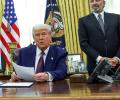
An hour before his bilateral meeting with Prime Minister Narendra Modi, Trump again commented on India's tariff structure, saying 'they have the highest tariffs' and 'it is a hard place to do business'.

A disagreement between mobile operators and device manufacturers over e-SIMs has reached the government with the Cellular Operators Association of India (COAI) asking the DoT to order handset manufacturers to introduce eSIMs, in addition to the physical SIM slot, in all smartphones costing over Rs 10,000. The reason is the unprecedented global shortage of semiconductors which has severely impacted the supply of SIM cards across the globe and pushed up the price by four to five times. The shortage is not likely to improve before 2024.
